Listen to this episode and subscribe to the FA podcast on Apple Podcasts, Spotify, Google Podcasts, Overcast, or wherever else you usually get your podcasts.
This episode focuses on Greece’s so-called new generation refugee camps, officially known as Closed Controlled Access Centres or CCACs. These are high-tech compounds located on islands such as Samos and Lesvos used to process, detain, and surveil people on the move.
You’ll hear from voices across spatial practice, activism, and journalism to unpack how these sites operate as extra legal spaces, contributing to a wider ongoing project of the intense management of migration.
This podcast was written by System of Systems, co-founded by Maria McLintock, Danae Io, and Rebecca Glyn-Blanco, and narrated Maria McLintock. It features the voices of Nishat Awan, Lydia Emmanouilidou, Dimitris Choulis, Neni Panourgia and Petra Molnar. Images and video from Petra Molnar. Sound editing by Cameron Christie.
This podcast is part of the FA special series Everywhere Walls, Borders, Prisons. Below is a transcript of the conversation.
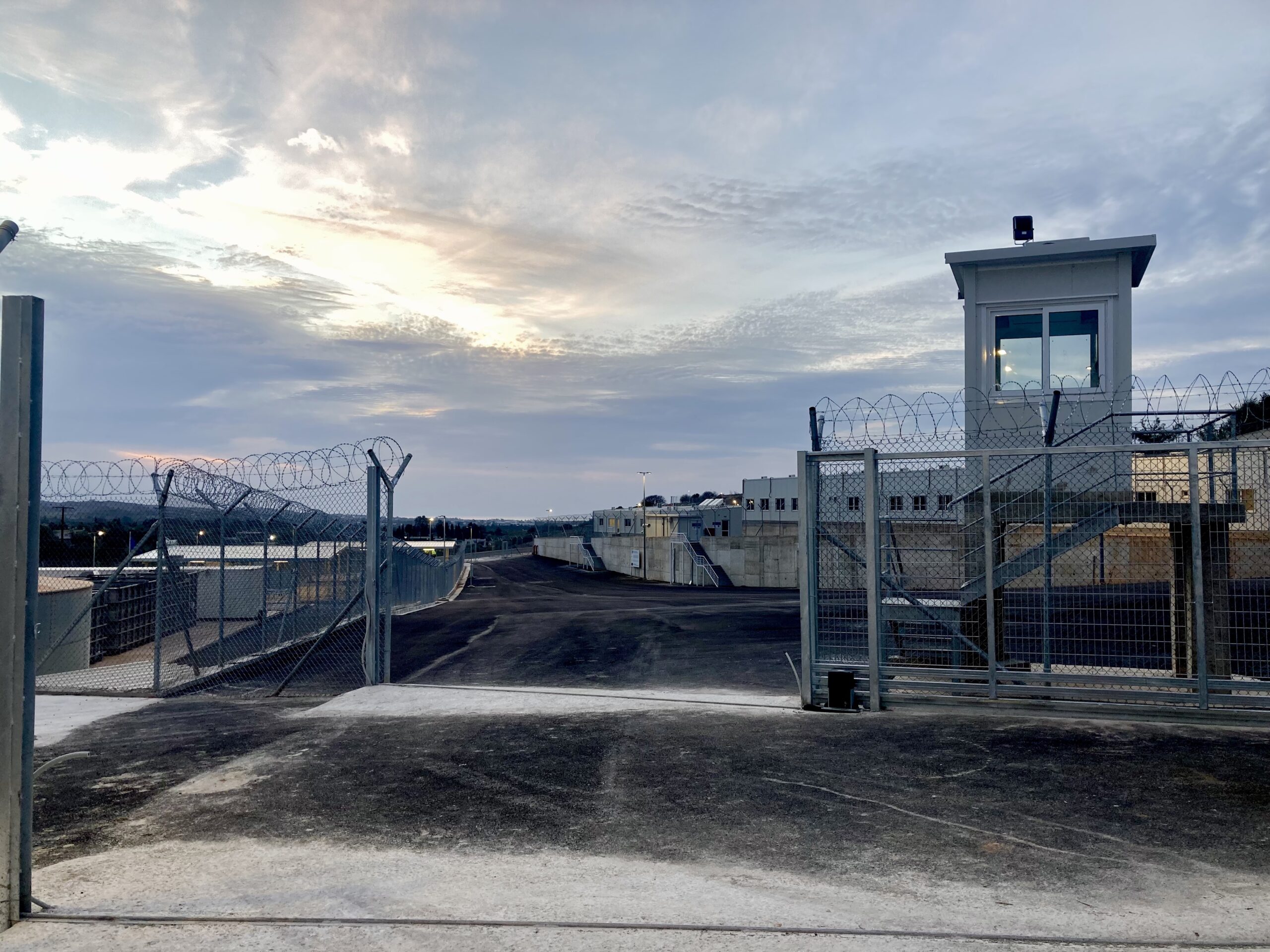
Moria CCAC, Lesvos
Petra Molnar
Nishat Awan: Hello, my name is Nishat Awan. I’m a professor of architecture and visual culture, UCL. And we’re sitting here in the urban lab. My work is really about thinking about migration, undocumented migration, and the production of borders, and how they intersect with architecture and spatial practice.
So, I think the CCACs, of course, they’re part of a broader architecture of surveillance as well as kind of containment.And so, if I think through the idea of surveillance, then within architecture, the kind of main model for thinking about surveillance is the Panopticon, Foucault wrote about this, of course.
Maria McLintock: In early 2021, in the midst of the COVID-19 pandemic and following a catastrophic fire in the overcrowded Moria refugee camp on the Greek island of Lesvos, the Greek Ministry of Migration and Asylum published a presentation called The National Strategy for Migration: Protecting the Aegean Islands.
This landmark document outlined how a €276 million fund from the European Union would transform Greece’s migration infrastructure, shifting away from so-called informal camps and reception centres across the Aegean Islands, previously known as multi-purpose reception and identification centres, towards a new regime of modernised, closed controlled access centres or CCACs.
These centres designed as high security compounds would now consolidate all asylum related procedures. From registration and interviews to confinement and pre-removal detention, within a single fortified environment. At the core of this new model lies a techno-securitised logic. Surveillance infrastructure, biometric access controls and automated monitoring systems would supposedly streamline migration processing.
Yet what the CCAC’s really represent is a deepening of long-standing policies of deterrence, containment, and exclusion, now embedded in an even more hardened architecture of control. As part of the wider CCAC project, the Greek government opened a centralised surveillance facility within the Ministry of Migration and Asylum in Athens, known as the Control Room.
This facility equipped with artificial intelligence, biometric tools, and predictive analytics, was designed to preemptively detect fires and identify so-called suspicious activity, crowds, gatherings, and movements in and around the camps supposedly in real time. The control room signals a new phase in migration governance, whereby risk forecasting and algorithmic decision making are operationalised.
The CCACs are located across five Aegean islands, Samos, Kos, Leros, Lesvos, and Chios. The centres on Samos, Kos, and Leros are currently operational. Lesvos and Chios are expected to be completed soon. Samos has drawn particular attention from human rights groups, due to the inhumane conditions of its CCAC which has been described as prison-like in both form and function.
The site exemplifies the carceral ethos of these new infrastructures. Remote, tightly controlled and deeply surveilled. These islands have functioned as so-called hotspots. Zones of the EU’s periphery where arrivals from the global south are first processed and where securitisation is most intensely applied.
The island geography not only reinforces a sense of separation from the European mainland, but also enables a kind of strategic invisibility, concealing the everyday violence and systemic neglect experienced by those seeking refuge. This shift towards CCAC’s reflects a broader reconfiguration of Europe’s migration landscape.
It exemplifies a neoliberal security-oriented logic that renders displaced people as a legalised subjects, bodies to be processed, monitored, and deterred. Even the terminology, closed, controlled access, projects an image of bureaucratic efficiency and streamlined management. Masking the underlying violence inflicted at the borders of the continent, these are not merely centres of reception, they are infrastructures of incarceration.
We spoke with practitioners working within and against this context. Historians, journalists, lawyers and researchers to unpack how the spatial dynamics of the CCACs intersect with broader European Union policies that diffuse control through technological, legal, and extra-territorial means, we hope to uncover how the CCACs function not only as instruments of deterrence, but also as spatial laboratories for a wider, nefarious, and well-financed migration management regime spreading across and beyond EU territory.
But these architectures are not without precedent. Later, we explore how Israeli surveillance companies have been contracted to supply technologies entangled in this landscape, part of a wider ecosystem of border tech exported from sites of occupation and colonial control, such as Palestine. This reveals how Europe’s bordering practices are historically entwined with older and ongoing forms of imperial violence.
Through these conversations, we ask, what exactly are the CCACs? What role do islands play in shaping these architectures of containment? How do these technologies amplify and harden already violent borders? And how do these infrastructures relate to histories and futures of carcerality? Here, Professor of Architecture and Visual Culture, Nishat Awan, talks about how these sites fit into a larger history of architectures of surveillance and exclusion.
Nishat Awan: Panoptican was essentially a kind of prison designed by Jeremy Bentham. The point of the panopticon was that if there was one person in the tower, they could see everyone, but at the same time because of the architecture, the prisoner even if no one was looking at them, the prisoner would always feel surveilled. So it was a kind of way of thinking about the relationship between surveillance and architecture very much through visibility, but also through the kind of affective response you have of being watched.
Bruno Latour talks about this concept of the oligopticon, which is thinking about the way technology and things work where you start from the very small scale and unfold outwards. And so when we think about questions of surveillance and architecture and the city particularly Latour uses this concept to think about Paris.
There were various series of ways of mapping Paris that he was looking at and one of them was how the CCTV network was surveilling the citizens especially within the metro system. And so here you see a question of carcerality and surveillance that is not so obvious as putting you in a prison and you’re controlled within a space, but more that there’s a series of technological devices that produce a kind of surveillance.
Lydia Emmanouilidou: My name is Lydia Emmanouilidou and I am a freelance journalist based partly in Athens.
So a closed controlled access centre or CCAC is a type of camp that we saw starting to emerge around 2021. They were supposed to be a revamped, more humane, more secure versions of the previous make-shift and encampments that we had seen popping up on the islands post-2016. Around 2016, 2015, we had hundreds of thousands of people coming to Greece and to other European countries, many of them coming through the Greek islands like Lesvos, Samos, and others.
And what we saw is these makeshift tent camps starting to emerge on all these islands and as people kept arriving, these camps grew more and more overcrowded. The conditions became worse and worse. In Moria camp on Lesvos Island, for example, they had no running water. There was basically no doctor or healthcare available for people.
People were living in completely squalid conditions. And for a variety of reasons leading up to 2021, the European Union said this is not representative of the EU. We cannot have people living in these conditions and waiting for years on end to go through the asylum procedure, which is what was happening. People were waiting for two, three, four, five years to hear back on their asylum applications.
And so the EU along with Greece said, we’re going to introduce this new generation of camps where people can live in much more humane conditions and also be able to go through the asylum procedure as is in line with EU law. That was the promise and the vision and of course what me and other colleagues have documented is very different from that vision.
The CCACs are spaces that are highly securitised. They are surrounded by double barbed wire fencing, NATO type barbed wire fencing. There are cameras, all sorts of other technology that can be monitored from a control room back in Athens, and there’s a heavy presence of security.
The first CCAC that opened was in the fall of 2021 on Samos Island. And this has been kind of the flagship camp, the one that Greek authorities bring officials to foreign officials when they come to visit. There is one on Kos Island, one on Leros Island. There had been plans for CCACs in Chios Island and on Lesvos.
The ladder has been built to a large extent, but people haven’t been moved in fully yet from what I understand for a variety of reasons, there have been legal challenges, on Chios it hasn’t even been constructed from what I know. The CCAC model is also being applied to the camp at the Greece-Turkey land border in Evros. There’s a camp there, if you can call it that, a detention centre really, where they have expanded it and they have also implemented a lot of the technologies that we see in the CCACs.
The first time I was in the Samo CCAC, me and my colleagues had three security people trailing us the whole time as we were going around trying to talk to people, which of course discourages people from talking when there are three police officers trailing the people holding the microphones.
It was very gray, very kind of clinical, carceral, very little green, actually no green at all, no greenery, so it’s this block of concrete and containers essentially, spaced out over really really vast areas that again are quite remote, especially in the case of Samos. You have to drive or walk a really long way to get up the hill to where the refugee camp is.
Maria McLintock: The CCAC that Lydia refers to here on Samos, was the first to open in 2021. It is located in a remote part of the island on the outskirts of the main city. Despite the EU promising that these centres would be “future proof facilities that would be up to EU standards with better living conditions.”
Amnesty International denounced Samos as a dystopian nightmare, citing numerous issues as Lydia addresses relating to overcrowding, living conditions such as no beds, some people even housed in canteens, an insufficient supply of running water, and a severe lack of medical services among others.
The CCAC is equipped with a rigid system of containment and surveillance, including double-barbed wire metal fencing, CCTV throughout the facility, and the 24/7 presence of patrolling police and privately contracted security officers. We also spoke to Dimitris Choulis, a lawyer for the Samos based human rights legal project.
The project was created in 2020, out of a need to urgently respond to the many human rights violations taking place on the island against refugees. For example, Samos has seen a huge volume of pushbacks. The currently illegal practice of cross-border expulsion by state-level actors. Dimitris shares the living conditions on Samos, which heavily contrast with the ministry’s emphasis on technological advancement and modernisation.
Dimitris Choulis: So everything around the CCAC, this is my opinion of course, and from what I have seen in Samos, everything is a facade. It’s a facade for people to see and to have these narratives, but if you scratch under the surface, you will see that nothing’s true.
First of all, it’s supposed to have doctors inside, and it’s supposed to have a lot of equipment, and they are closed since 2021, that we bought them and no one use them because we didn’t have doctors. So, you can say you see there is this, but it’s like fair. Everything is fair. Only the abuses are real.
So, there are the systems, there are the behavior, analysis, but the old fashion, good old fashion, violence against them is always a solution. From the cases that I have seen and it’s a lot of cases that they criminalise them. I had never had the footage of what has happened, but we haven’t seen be used for the good of the of the people.
It’s very important to understand that these people at some point they were leaving the new camp to go outside and they were not coming back. They were going to the old camp that was a hill just to sleep without all these cameras and all these uniform men around them. Because when you have people traumatised and you have all these cameras knowing that you have zero privacy.
What led to this is that after 4 years of this CCAC working, we see that actually nothing is working as it was supposed to. We know that the food is not good. We know that there is no maintenance in the containers where there is nothing working most of the time, not even the cribs or the oven. And the problem is that they give you one spread daily of food and you need to have it somewhere.
The biggest problem and example of the situation of this new camp is the lack of water. Since day one, they cannot have water, running water, inside the camp. Employees and the refugees residing there cannot even flush the toilet. Even the employees, even the unit inside employees, they bring bottles with them to throw to the toilet. This is something that it was known that the area has a problem with water.
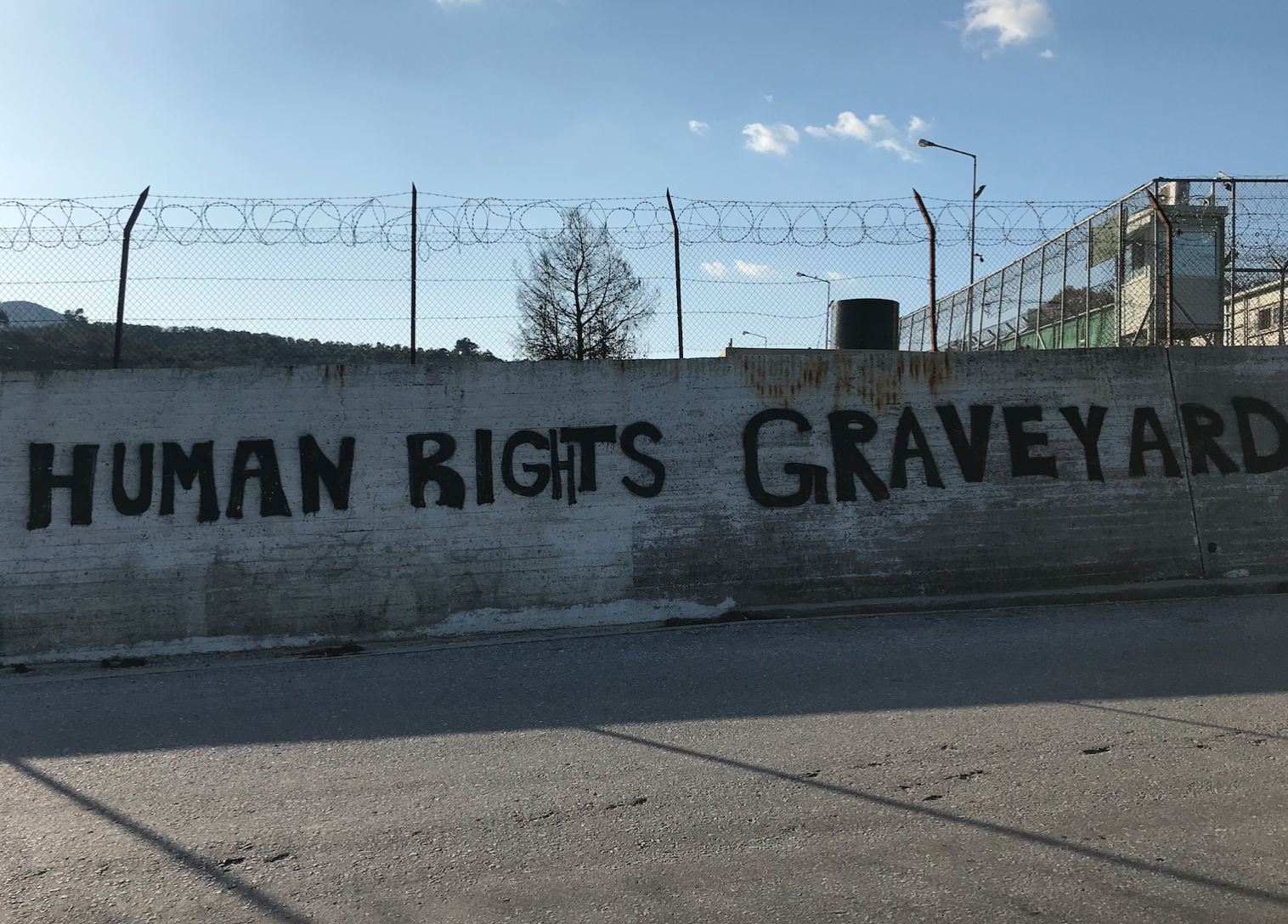
Maria McLintock: In February 2025, a group of organizations, including Dimitris’ Human Rights Legal Project and Amnesty International, among others active in the field of refugee rights in Greece, came together to draft and sign a letter addressing the shortfalls and violations evident at the Samos CCAC, addressed to the Internal Affairs and Migration Commissioner, Magnus Brunner, the letter urges that “unlawful detention and substandard conditions must not become a blueprint for the EU migration pact.”
A set of reforms designed to overhaul the EU’s approach to migration and asylum which effectively harshens the already hostile migration landscape yet under the guise of streamlining.
Central to the letter are two concerns. First, the use of systemic, unlawful, and arbitrary detention in the Samos CCAC. Second, the human rights concerns emerging from inadequate living conditions.
The letter opens by quoting a Palestinian from Gaza and resident of the Samos CCAC who shares, “In the hierarchy of humanity, you have the human, the tree, the animal, but in the camp, the hierarchy is upside down. The human is at the bottom of the pyramid. I see the authority giving food to the dog, but they won’t open the door to the human when they need to go to the hospital.”
Dimitris Choulis: Nothing is what it was advertised to be a place that for a small period of time until you have identified yourself and you have the papers to move on, it will be humane.
Nothing is humane. This is what it led to this a letter and It’s important for the EU and EU Commission to understand the situation here, because always they hide it and what I can say and what we know is that in contrast with the previous situation where it was an emergency and there were violations in the outcomes because of the emergency. This is something that systematically we have decided that it will mistreat people. It will have a normalised barbarism inside, a normalised situation of dehumanisation of these people. That they don’t even deserve food and water and this is why we ended up in a place where we say we cannot do this anymore.
It’s not when it’s not overcrowded. It’s not terrible per se. It’s not inhumane because people are getting killed, but it’s inhumane because it’s a constant limbo of barbarism, fences, police violence, and no vote.
Maria McLintock: Neni Panourgia is an anthropologist and the academic adviser at the Justice and Education Initiative at Columbia University. She is the co-founder and co-organiser of the Leros Humanism Seminars, an annual gathering on the island of Leros. Her research focuses on confinement, particularly in relation to island conditions across Greece. Her new book Leros: The Grammar of Confinement is published in Greek and forthcoming in English.
Neni traces a historical legacy of containment on Leros, an island marked by overlapping infrastructural histories that have shaped its social and material fabric. She maps the layering of naval bases, army barracks, a prisoner of war camp, a rehabilitation school, and a psychiatric hospital that operated on the island for decades.
Ultimately, a sequence of open and closed forms of institutional confinement that prefigures the construction of the island’s recent CCAC.
Neni Panourgia: Understanding on the local level that what happens in those camps is something that does not happen out in the open social sphere is there already, right?
So from the beginning that place which is the same place, those buildings which were the same buildings have been established in the local not just imagination but in the local experience as something that is easier to get into than to come out.
Now, the majority of the people who are there, and this is what this particular camp has been built for, are people who have been denied asylum elsewhere in Europe and are being sent back to the original place where they entered. It is really a no man’s land because they are primarily or almost exclusively people who can’t go back. They can’t go anywhere, right? And they, a lot of them, will just stay there for years and years to come.
So Leros is very far away from the mainland. It really exists on a boat line which is called Agongrami, the infertile line. The unproductive line, the infertile line and it’s very close to Turkey. But the island itself is also sort of infertile, right? It’s both because it’s a small and sort of rocky place, but also because during the Second World War, it received so much bombardment by the German and the British Air Force. 500 tons of bombs were dropped on the island that the island became toxic and really infertile for a very very long time. So it is a place that by its geography is not friendly to self-sustainment. So these interventions by the various states and constitutive powers have actually landed, so to speak, on the understanding of the lack of self-sufficiency and lack of autarchy of the of the people on the island.
So they have been presented as an opportunity to the island by bringing in funds that the island lacks in order to be able to sustain itself. So over half of the island population since 1923 has been working on that small that’s called Lepida that had the naval base, and the prison of war camps, and the psychiatric hospital, and the rehabilitation. So over half of the island’s people have been working there.
The geography itself has actually determined to a certain level the establishment of the place, of confinement places, and its interaction with the local population.
Maria McLintock: Dimitris’ ongoing engagement with the conditions on Samos and Neni’s historical positioning of Leros reflect the transmutation of Greek islands into stages for, and containers of, historical harm enacted against asylum seekers and refugees. In this context for state-level actors, certain Aegean islands function as sites of banishment.
As Nishat posited earlier, technologies in their broader sense have long been entangled with the harsh strategies of displacement and migration management. Whether in the form of prison architecture or emergent systems of surveillance and monitoring. This entanglement was starkly evident in the announcement of the CCACs. In November 2021, then Minister of Migration Notis Mitarachi posted two images on Twitter to announce the opening of a new control room within the Ministry of Migration and Asylum. One image captures a group of masked officials seemingly marveling at the room’s high-tech infrastructure. Tours of the space were even offered to university students. The other reveals the technological setup itself, a curved multi-screen unit, reminiscent of a sci-fi-esque command centre, displaying live feeds from surveillance systems monitoring the CCACs. At that point, possibly only the CCAC at Samos.
Central to the conservative government’s asylum policy, the perion and Sentar systems have drawn criticism from human rights organisations for depriving asylum seekers of their fundamental rights and freedoms. Both systems were launched and operated for up to 18 months without undergoing basic data assessments by the EU. Despite the EU having reviewed and approved their implementation, the image of the control room itself begins to function as a form of visual deterrence. A spectacle of control intended to signal outwards and inwards, the government’s commitment to high surveillance, low accountability border regimes.
Lydia Emmanouilidou: There are two main tech systems I have been following deployed in the CCACs. One of them is called Sentar and it’s this automated threat detection system which does what its name indicates supposed to automatically detect threats using AI. So there’s hardware in the camps including cameras, sensors, drones. Officials were even talking at the beginning, when I was speaking to them about the system, about deploying augmented reality glasses so that the guards could wear them.
So all of this hardware that I described has a live feed to local control rooms and a centralised control room in Athens which I had a chance to visit and it’s what you would imagine the control room to look like. You can see different parts of each camp, you can move the cameras and peer into them. We even saw cameras installed in spaces that looked like they should be private spaces like containers. So, this is one system, Sentar, what it’s supposed to do is use cameras, and other tech, to automatically detect threats. So, for example, if a camera sees someone holding something that looks like a weapon, maybe it’s a knife, maybe it’s a gun, it’s supposed to automatically alert authorities that there’s danger and they’re supposed to get a protocol to respond to that incident. If there’s a large crowd gathering, if an unauthorized vehicle enters an area, and so on and so forth.
The second system is called the Perion and this is primarily an entry and exit system because people are allowed to leave during certain hours of the day, but it’s very controlled, so people have to use their biometric data and specifically their fingerprints and scan their fingerprints to go in and out of the camp. And this system primarily tracks that entry and exit. It’s, you know, the controlled access that is in the name of the CCACs.
Petra Molnar: My name is Petra Molnar. I’m a lawyer and an anthropologist, and I have been trying to understand the interplay of technologies in migration since about 2018. So I first came to Greece in the summer of 2020 in the middle of the COVID pandemic. My colleague Sean Rehaag and I were just about to open the refugee law lab, our research laboratory at York University, and we wanted to expand the work that we were already doing in Canada at the intersection of migration and tech. And Greece was a case study that we were really interested in because Greece was weaponising COVID as a way to trap people inside refugee camps and not letting them have free movement even though it was open for tourism.
And so I thought, like a good ethnographer, I would go for a few months and I stayed for nearly two and a half years, because Greece was, or is really, such an important piece to the story of trying to understand how technologies and migration interplay. Most of my work actually started on Lesvos Island, I was there when the fire happened in September of 2020. But then Samos really became one of the epicentres, if not the epicentre, because it was the first island where the new CCAC opened. And that became such a point of interest and importance in this story because it really showed this kind of flow of money, flow of technology from the EU into these Greek spaces. Even if we strip away all the technology, it’s very clearly a carceral space. Like the word refugee camp does not come to mind, you know. It looks like an open air prison. It’s full of concrete. It’s inhospitable. It’s far away from major cities, doctors, lawyers, even the ability to take your child up for a walk – you’re literally stuck and geographically segregated.
I think there is an important reminder in all of this though, people who are incarcerated, even in immigration detention, not to mention a refugee camp, have not committed a crime, it’s administrative detention. It is this kind of conflation, right, of criminalisation and migration or cremigration, as we call it sometimes, that is the foundational logic that allows us to normalise carcerality in migration. But again, it should be a space of refuge and an ability for people to put their cases, for example, together, right? In a way that would allow them a meaningful opportunity to claim asylum.
There’s also been some investigations into transnational companies, including Israeli companies that have made inroads into the Greek migration management space. We’ve been seeing that during the genocide in Gaza, but also much longer in the occupied Palestinian territories where technology, like automated weapons, surveillance, biometrics have been tested there on Palestinians years, and then sold as “being battle tested” to border enforcement officials, for example. In the EU, we’re seeing heron drones patrolling the Mediterranean. At the US-Mexico border, those AI surveillance towers that are dotted throughout the Sinai Desert, those are all Elbit Systems towers in Israeli company. So, there is this outflow that happens from these spaces of apartheid and occupation into border enforcement.
It’s really, really important to pay attention to what Israeli companies in particular are doing, because they are such major players, again, in this kind of border industrial complex that has grown up around the use of tech at the border.
Lydia Emmanouilidou: I had a chance to see some of the hardware, some of the logos of the companies involved, because, as you can imagine, the Greek government is not very forthcoming with that information. So, one of the things that I noticed during that visit was an orange circle logo that after research realised is this Israeli company called Octopus, and there are several companies involved in the hardware and software of this ecosystem. Octopus, which also has contracts with the Israeli government, is the centralised platform where authorities can monitor all the data that’s coming in from the various feeds, and this is the software that’s supposed to provide the automatic threat detection.
Viasat is also an Israeli company that is involved, and they were specifically, after doing a data subject request, discovered that the camera footage that they got back from the Greek migration ministry had this logo Viasat on it. And what we were able to piece together is that this is the company that does the analytics on the video specifically. So if there is, again, somebody holding something that looks like a weapon or if you’re trying to identify one particular person, Viasat would be providing the software that would do that within this whole system. And I have to say like there’s so much we don’t know about how the system works all together. The companies that are involved in Greece are really not surprising because they’re kind of the usual suspects involved in these projects, but the Greek government has been really secretive about the companies involved and exactly what they do. So, it’s taken, you know, the kind of reporting I described to be able to piece together who’s involved and looking at some contracts and things like that.
Nishat Awan: The dark side of technology that we see so often in questions around migration and borders was really not present.And so I think for us, as people who sort of work within this kind of field of architecture, borders, migration, that is about revealing the complicities of architecture within this, you know, from the really simple point that, you know, somebody designs these buildings, somebody, even if it’s not the design, somebody does the kind of permissions that allow the planning permissions, the building regs, all of that, right? So, we’re very much involved in that sense.
But then also, you know, we have a skill of kind of understanding systems in particular ways and of unpacking them and of following the spatial implications of certain kinds of very large scale systems. And so I think what architecture can bring to the table is a way to understand what can sometimes seem like an incredibly complex situation. So I think yeah, the methodologies of architecture are quite helpful in thinking about these things. But then of course, you know, I’m part of this group architects for Gaza, there’s also the kind of activist side of things of how you literally just, make something visible that is not being talked about and how through unpacking the complicity of architects within the architecture profession, I should say, within certain kinds of processes, you know, we can also make a difference.